Who Was Reynolds? 8 Theories About the Name Edgar Allan Poe Called on His Deathbed

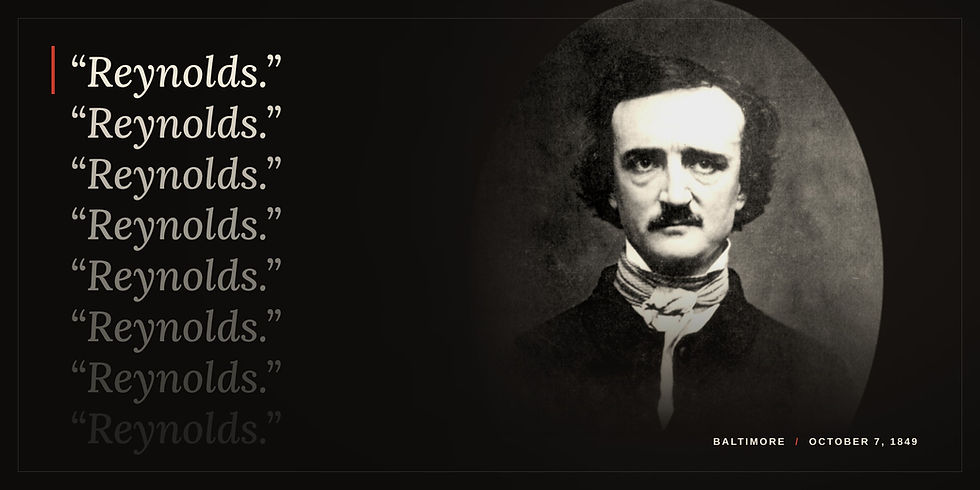
Edgar Allan Poe died in a Baltimore hospital on October 7, 1849, after calling the name "Reynolds" through his last night. Nobody has identified Reynolds. Scholars have proposed six candidates, and this list adds two readings that are speculation. The two best known are a polar explorer Poe admired and an election judge who worked at the polling place where Poe was found.
The Reynolds cry rests on one witness, his doctor, John J. Moran. In a letter to Poe's mother-in-law dated November 15, 1849, Moran wrote that Poe called for "Reynolds" until three on Sunday morning. Then Poe said, "Lord help my poor soul," and died. He had been found four days earlier at a tavern polling place, barely conscious, wearing clothes that were not his.
1. Was It Jeremiah Reynolds, the Polar Explorer?
Jeremiah N. Reynolds spent years lobbying Congress to send an American expedition toward the South Pole. Poe praised him in print in 1837 and borrowed long passages from his speech for The Narrative of Arthur Gordon Pym, the novel that ends with a giant white figure rising at the bottom of the world. A J. N. Reynolds also appears in Poe's 1842 bankruptcy petition, owed ten dollars.
The theory began as a cautious footnote by the editor James A. Harrison in 1902. No document records a meeting between the two men, though the ten-dollar loan and a line in Poe's 1837 review suggest they knew each other. By the count of the scholar Burton Pollin, Poe last mentioned Jeremiah Reynolds in print in 1844.
2. Was It the Author of a Novel Called Miserrimus?
Frederic Mansel Reynolds wrote Miserrimus (1832), a grim short novel narrated by a murderer headed for an unmarked grave. The title comes from a real tombstone in Worcester Cathedral carved with one Latin word meaning "most wretched." Poe cited the book five times in his criticism. The last time was April 1849, six months before he died.
Pollin proposed this candidate in 1970 and conceded that the question cannot be settled. After Poe died, the poet Richard Henry Stoddard wrote unkind memorial verses about him. Stoddard titled them "Miserrimus."
3. Was It a Playwright Poe Had Quoted for Years?
"The Gold-Bug" opens with two lines about a man bitten by a tarantula. Poe credited them to a comedy called All in the Wrong, where nothing like them appears. The editor Thomas Ollive Mabbott traced the idea to a prose speech in The Dramatist, a 1789 comedy by Frederick Reynolds, and concluded that Poe turned it into verse himself. Mabbott also found that Poe had quoted the same scene in an 1836 review.
This is the weakest candidate for the deathbed. It shows that the name Reynolds had been in Poe's reading for more than a decade.
4. Was It the Election Judge at the Polling Place?
Poe was found on election day at the Fourth Ward polls. One of the judges at that poll was a Baltimore carpenter named Henry R. Reynolds. James H. Bready reported the find in the Baltimore Sun on October 7, 1949, the hundredth anniversary of Poe's death. Philip Van Doren Stern made the same identification in the Saturday Review eight days later.
The find fits the cooping theory. In that account, election gangs seized men off the street, filled them with liquor, and marched them from poll to poll in borrowed clothes to vote repeatedly. No evidence shows that Poe and the judge spoke. Mabbott, the leading Poe editor of his day, agreed with an early Baltimore witness that the cooping story was "twaddle."
5. Was It a Family Who Lived Near the Hospital?
Moran told the story again in the New York Herald on October 28, 1875. The night of shouting is gone from this version. Moran wrote that he had sent for "a family named Reynolds, who lived in the neighborhood of the hospital," and that the women of the family came.
Pollin counted sixteen people named Reynolds in the Baltimore directory for 1845. No researcher has traced the family.
6. Did Poe Say "Herring"?
Moran published a third version in 1885. The same sentence appears nearly word for word, and the family is now named Herring. Henry Herring was Poe's uncle by marriage and had helped put him in the carriage for the hospital. In 1987 the scholar W. T. Bandy argued that Reynolds was the doctor's mistake, corrected decades later without comment.
The two names sound nothing alike, which weakens the idea of a mishearing. Moran is also a shaky witness. In his three accounts, the hour of Poe's death moves from after three in the morning to midnight. The date of his admission changes twice.
7. Was Poe Saying "Renounce"?
Poe may have been saying a word. In August 1849 he joined the Sons of Temperance in Richmond and swore off alcohol. In October 1849 the New York Organ, a temperance weekly, held him up as a warning and urged readers to "resolve to touch not, taste not the cup that poisoned him." A dying man with that pledge on his mind might cry "renounce."
This reading is speculation. No witness reported it.
8. Was It Poe's Own Teenage Alias?
In 1827 an eighteen-year-old Poe left Richmond for Boston, and a letter that reached the Allan firm days later was endorsed "to E. A. Poe, alias Henri Le Rennet." The alias is thought to be a French version of the name of his older brother, Henry, who died in Baltimore in 1831. Said aloud in a failing voice to a doctor who had never heard it, "Le Rennet" could pass for "Reynolds."
This reading is also speculation. The alias dates from twenty-two years before his death.
Which Account Can Be Trusted?
Moran's 1849 letter is the only account of the deathbed written within weeks by someone who was there, and Moran changed his story twice. Every theory has to start from that letter.
Readers can weigh the evidence themselves. Bandy's essay and Pollin's chapter are free to read at the Edgar Allan Poe Society of Baltimore.
The Reynolds mystery runs through Prophet, Bird or Devil, a novel by Nathaniel Free.
Sources
John J. Moran to Maria Clemm, November 15, 1849, printed in Dwight Thomas and David K. Jackson, The Poe Log (1987), pp. 845-846.
John J. Moran, "Official Memoranda of the Death of Edgar A. Poe," New York Herald, October 28, 1875.
James H. Bready, "Poe's Dying Cry for Reynolds," Baltimore Sun, October 7, 1949.
Thomas Ollive Mabbott, "Motto for the Gold-Bug," Collected Works of Edgar Allan Poe, vol. 1 (1969).
Burton R. Pollin, "Poe as 'Miserrimus,'" in Discoveries in Poe (1970).
Burton R. Pollin, notes on the sources of Pym, Collected Writings of Edgar Allan Poe, vol. 1 (1981).
Edgar Allan Poe Society of Baltimore, "The Mysterious Death of Edgar Allan Poe".
Comments